
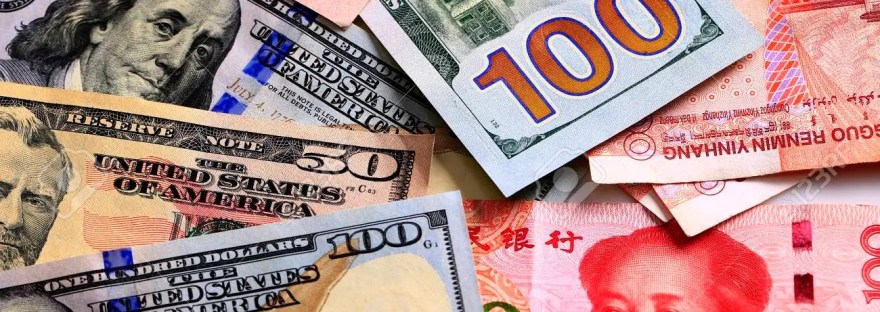
Economic sanctions on Russia following its invasion of Ukraine have underscored the formidable power of the US dollar while simultaneously highlighting the risks associated with heavy reliance on it. This has sparked renewed discussions about the potential for China’s Renminbi (RMB) to evolve into a credible global reserve currency. However, for this to happen, Beijing would need to significantly loosen its grip on the Chinese economy.
The Rise of the Renminbi
Over 70 central banks now hold some Renminbi as a reserve currency. Many African nations and some Middle Eastern countries regularly use it for transactions. Additionally, more than 1,900 financial institutions utilize the Renminbi for payments to China and Hong Kong. Central banks have diversified their holdings over the past two decades, reducing the dollar’s share of global reserves, according to the International Monetary Fund (IMF).
The Renminbi’s popularity as an international currency has been steadily increasing over the last decade. It recently ranked as the fourth most-used currency for cross-border payments, achieving this position for the first time since August 2015.
Strategic Moves and Global Impact
China has actively promoted greater Renminbi adoption across Africa. Its recent negotiations with Saudi Arabia regarding a Renminbi-based oil deal suggest that nations are considering alternatives to the US dollar. This would break Saudi Arabia’s 50-year precedent of exclusively trading oil in dollars.
The IMF notes that the dollar’s dominance is being challenged as reserve managers diversify their portfolios. Approximately a quarter have turned to the Renminbi, while three-quarters are exploring non-traditional currencies from countries that usually play limited roles as reserve assets.
China surpassed the US as the world’s largest goods trader in 2014 and has been the leading exporter for a decade. However, there is a notable disconnect between the high volume of global trade involving China and the predominance of US dollar transactions.
Challenges and the Path Forward
Despite these trends, the US dollar still dominates, comprising 60 per cent of global reserves compared to the Renminbi’s 2.5 per cent. In global payments volume, the dollar accounts for 41 per cent, while the Renminbi stands at about 3 per cent, even though China is the world’s second-largest economy. The euro holds the second spot with a 37 per cent market share, followed by the pound and the yen.
The current international monetary system is highly asymmetric, with most countries aiming to maintain a stable exchange rate with the dollar. In contrast, the US does not need to worry about the value of its currency relative to others.
Several barriers hinder the Renminbi’s ascent as an international invoicing currency, including China’s capital controls, the lack of capital account convertibility, the immaturity of the Chinese financial system, and the persistent use of the US dollar for international transactions.
What China Needs to Do
For the Renminbi to become a leading global reserve currency, China must undertake several significant reforms:
- Market Liberalization: China needs to open its markets and reduce government oversight to create a more inviting environment for foreign investors.
- Currency Stability: China must demonstrate the long-term stability of the Renminbi to gain the trust of other nations.
- Refrain from Currency Manipulation: Avoiding practices like devaluing the Renminbi to boost exports is crucial to establishing credibility.
- Financial System Maturity: Developing a more robust and mature financial system is essential for the Renminbi to gain wider acceptance.
Conclusion
The Renminbi’s journey to becoming a global reserve currency is complex and fraught with challenges. While its use has grown significantly, and it presents a potential counterweight to the US dollar, China must implement substantial reforms to achieve this goal. Only with a more open and stable economic environment can the Renminbi hope to play a much larger role on the world stage.
 Indrajit Roy Choudhury
I don’t think that the USD can be removed from its position. The world has faith in the depth of the US financial markets and the US institutions. This trust is built over a period and it’s independent of the political dyanamics.
Yes, the US dollar enjoys a very strong position and enjoys a huge trust globally.
Free float I believe would be an essential precondition. Also, with the emergence of e-currencies, why not a global currency?
That’s right, sir. Without free float, it’s not possible. A global currency is a myth, at present. Let’s see if digital currencies can break that myth. It’d be an interesting world then.
It is true that for quite some time countries have been seeking an alternative to the USD. Unfortunately, given the lack of transparency in the Chinese economy as well as other policies, the chances of the Chinese RNB replacing the USD are remote. While China can definitely use its influence to increase its acceptance, especially among the poor and undeveloped nations that depend on China in some form. But on a global level, it is a distant dream.
You’re right, Arvind. While the renminbi has the potential to become a significant reserve currency, it is unlikely to attain safe haven status in near future. China needs to relax its capital controls, allow more convertibility of the RMB, and reform its financial sector much more deeply in order for the offshore RMB market to achieve the required market thickness to become a major invoicing, investment, or even reserve currency in the Asia-Pacific region and beyond.
True. Unless the image of the government improves, the faith in curency will be shaky.
👍👍
With USD and EUR having more than 2/3rd market share, RMB posing a challenge is a distant dream despite being the second-largest economy and having the largest share of trade. It’s primarily because of governmental control of the RMB and the Chinese economy.
You’re correct, Sanchita.