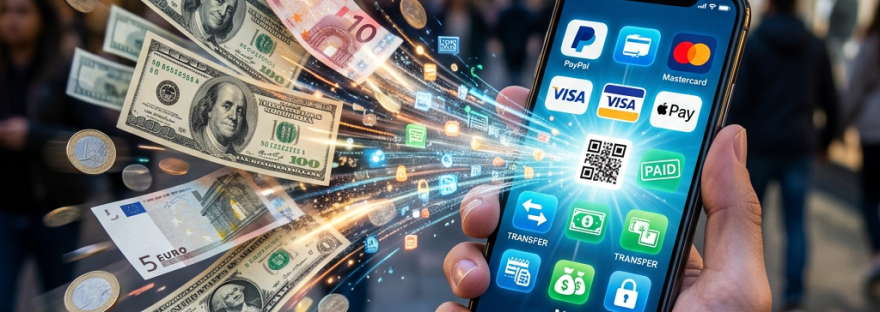
The Iraqi economy, historically reliant on cash, faces a transformative shift with the Central Bank's introduction of digital banks. These banks aim to enhance financial inclusion by leveraging mobile technology, addressing traditional banking barriers. They promise quicker account setups and innovative services, aiding SMEs and fostering credit access through data history. However, robust regulatory frameworks and cybersecurity measures are essential for successful implementation and economic stability.
Blog
Iraq’s Cashless Gamble: Can the Central Bank Transform a Nation’s Payment System by July 2026?
The Central Bank of Iraq aims to eliminate cash transactions by July 2026 as part of a major financial modernization initiative. This shift could enhance digital banking and financial inclusion but poses significant operational challenges. Iraq is developing a national payments infrastructure, including an instant payment system, a unified government payment gateway, a domestic card scheme, and a national switch. Success hinges on public adoption and the readiness of the banking sector, setting the stage for a pivotal transition.
The Cost of Waiting: Why Indecision Is a Strategic Risk
In rapidly changing markets, leaders often hesitate, thinking it prudent to gather more data. However, this indecision can erode competitive advantage and incurs hidden costs. High-performing organizations excel by acting decisively under uncertainty, prioritizing speed over perfection. Cultivating a culture of decisive action and adaptability can lead to strategic momentum and resilience, as timely decisions often surpass delayed but ideal ones.
The 1979 IBM AI Memo Revisited: Is Human Accountability Still Superior?
The future promises more intelligent machines, advanced automation, and sophisticated decision-making systems. AI will analyze data with great precision, detect patterns beyond human intuition, and guide decisions efficiently. However, society will still require humans to stand by decisions and accept responsibility for their outcomes. Rather than choosing between human intuition and machine logic, an ideal system combines AI's transparency, analysis, and consistency with human ethical judgment and accountability. This partnership ensures balanced, responsible decision-making in an increasingly automated world.
Relationship Banking: Learning When Size Stops Mattering
Somewhere along the way, I learned that size in banking is often mistaken for significance. Large exposures can feel meaningful internally, yet remain invisible to the client. True relationships are not built on headline numbers or borrowed prestige, but on relevance—on whether, in the client’s world, you actually matter.
From Tick-Box Compliance to Forensic Scepticism: Lessons from the IDFC FIRST Bank Chandigarh Fraud
₹590 crore lost, controls intact—on paper. The IDFC FIRST Bank Chandigarh episode exposes a hard truth: compliance doesn’t equal control. When insiders collude, maker–checker frameworks become rituals. Internal Audit must move beyond tick-box reviews to forensic skepticism—questioning data, analysing patterns, and confirming balances independently—before frauds surface through clients instead of controls.
Echoes from Mesopotamia: When a Dream, a Land, & History Converge
A personal milestone. A long-cherished dream realised. I’m proud to share my book Echoes from Mesopotamia, recently published and launched at the Kolkata Book Fair (Boi Mela), 2026. Shaped by sixteen years in Iraq—the land often called the Cradle of Civilisation but one that became a second home—the book journeys through the myths and legends of Sumer, Akkad, and Assyria, drawn from research, lived experience, and quiet listening among the echoes of the Tigris and Euphrates. Seeing these echoes find a home between the covers of a book is a dream sixteen years in the making.
Navigating Iraq’s New Import Landscape: Understanding the CBI’s Prior Declaration System
Starting December 1, 2025, Iraq's Central Bank will mandate a Prior Declaration System for imports, enhancing financial transparency and combating fraud. The system links goods with financial transactions before currency transfers, improving customs revenues and modernizing trade. Importers must precisely document and coordinate with banks and customs to comply with new requirements.
Synthetic Phishing: The AI-Powered Threat Undermining India’s Digital Payments Revolution
Synthetic Phishing utilizes AI-generated deepfakes and synthetic identities to execute highly convincing scams, posing an urgent threat to India's digital payments system. This new form of deception exploits trust and bypasses traditional security, especially targeting the instantaneous, irreversible nature of UPI. Banks, regulators, and users must upgrade defenses and digital literacy to protect the nation's financial future.
When Everything Becomes Homeless, It Finds Its Way to the CFO’s Table
In every transformation I’ve lived — from Aligarh’s curfew-shadowed lanes to Iraq’s rebuilding boardrooms and the digital corridors of the Middle East — one truth stands out: every “homeless” problem eventually lands on the CFO’s table. Not because Finance seeks control, but because it alone holds the clarity, coherence, and courage to connect the entire enterprise.