

Central Bank Digital Currency (CBDC) is the latest buzzword in the world of finance and banking. According to the Bank for International Settlements (BIS), 9 out of 10 central banks are exploring CBDCs, and more than half are now developing them or running concrete experiments.
The Indian government has taken a major step towards digitization by launching a CBDC wallet. This move is expected to revolutionize the way financial transactions are conducted in the country. As a tech enthusiast, an experienced banker, and an avid follower of the latest trends in the financial industry, I decided to open a CBDC wallet in India.
The CBDC wallet is a digital wallet that allows users to store, transfer, and receive digital currencies. It is a secure and convenient way to access digital currencies, as it eliminates the need for physical currency.
What are central bank digital currencies (CBDCs)?
A CBDC is central bank-issued digital money denominated in the national unit of account, and it represents a liability of the central bank. If the CBDC is intended for use by the general public it is referred to as a “general purpose” or “retail” CBDC. As such, it offers a new option to the general public for storing value and making payments. A CBDC is different from existing forms of cashless payment instruments for consumers and businesses, such as credit transfers, direct debits, card payments and e-money, as it represents a direct claim on a central bank rather than the liability of a private financial institution.
CBDC is a secure and efficient way of transacting in digital currency, eliminating the need for intermediaries such as banks. CBDC is also expected to provide greater financial inclusion, as it can be accessed by anyone with a smartphone and internet connection.
In India, the Reserve Bank of India (RBI) has launched the pilot of its central bank digital currency (CBDC), which it categorizes as legal tender in a digital form. Commonly known as the digital rupee, it will be exchangeable at par with existing currencies and will be considered acceptable for payments and a safe store of value.
Also called the e₹, CBDC issued by the RBI is aimed at creating an additional option to use money and isn’t very different from the currently issued banknotes; only the digital rupee is expected to be transacted digitally and facilitate ease of use.
The Digital Rupee app can be used by customers to load, store and transact using digital rupee currency in a safe and secure way digitally. You can pay for purchases by scanning the merchant’s QR code (Person-to-Merchant).
The digital rupee is available in denominations of e₹2, e₹5, e₹10, e₹20, e₹50, e₹100, e₹200, e₹500 and e₹2000 that can be termed as Digital rupee banknotes.
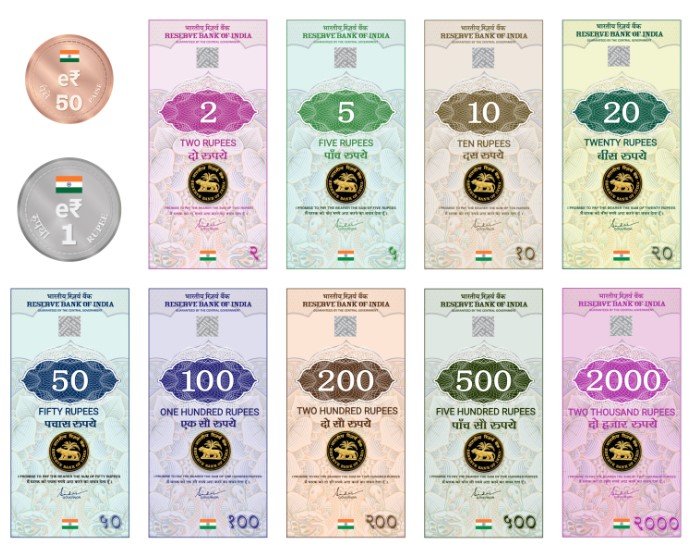
The digital rupee is the RBI’s accepted version of cryptocurrencies, which the central bank has dismissed repeatedly and called a serious challenge to the stability of the financial system of the country.
Unlike cryptocurrencies, a CBDC isn’t a commodity or claims on commodities or digital assets. Cryptocurrencies have no issuer. They are not money (certainly not currency) as the word has come to be understood historically.”
Reserve Bank of India
The launch of the Digital Rupee wallet in India is a significant development, as it is one of the first countries in the world to adopt this technology. The government has been working on this project for some time now, and it has finally come to fruition.
I was at home last week on vacation. I received an SMS notification from my bank, HDFC Bank, asking me to download the app for the Digital Rupee wallet. I downloaded the app. It first verified my SIM and then asked for my mobile number… I entered it. Voila! The wallet is opened for me. It is a simple and hassle-free process. I could see the images of currency notes in circulation. I loaded some amounts via Unified Payment Interface (UPI). My Digital Rupee account was instantly credited, and the wallet was showing how many currency notes of each denomination I was holding. That’s amazing! I told my son. After me, he also opened his Digital Rupee wallet.
The Digital Rupee wallet is expected to have a significant impact on the Indian economy, as it will make financial transactions faster, cheaper, and more secure. It will also help in reducing the cost of printing and distributing physical currency.
The e₹ wallet is also expected to help in reducing fraud and money laundering. As all transactions will be recorded on a blockchain, it will be easier to track and trace any suspicious activity.
While much is still unknown about the future of CBDCs, a fuller picture of their benefits and disadvantages will emerge with time. One thing is clear: CBDCs have the potential to significantly affect the world.
The launch of the e₹ wallet is just the beginning of India’s journey towards digitization. The government has also been working on other initiatives, such as the Digital India campaign, which aims to provide digital infrastructure to all citizens.
India has already made significant progress in the field of digitization. With the launch of the e₹ wallet, it is expected to take a giant leap forward. The government’s focus on digitization is expected to have a positive impact on the economy, as it will help in reducing costs, increasing efficiency, and promoting financial inclusion.
By introducing the digital rupee, the RBI expects to address problems associated with existing physical currencies and cross-border transactions. While there are some challenges associated with using digital currencies, the benefits outweigh the risks. As India moves towards a more digital economy, it is imperative that we embrace new technologies such as CBDCs to ensure greater financial inclusion and security.
 Indrajit Roy Choudhury
The only constraint right now is that most ppl are unaware of this. So, technically one can transact with very limited ppl now. Hope, this payment interface gets attention of the masses.
The Digital Rupee is currently on the pilot so its usage is much less. You are right that awareness needs to be spread, Maybe after the successful pilot phase, the publicity will be increased. I used it personally. It’s nice and seamless.
Yes ,it’s seamless . Also, comes with a following situation – will this put a block on the united paymwnt I terraces currently available??
UPI is more expensive because of intermediaries. The digital wallet will definitely take away its load as and when it picks up. It’s on pilot run now. Things will be clear based on the experience, CBDC is the future. Almost 130 countries are at various stages of development of their versions of CBDCs.
How is this different from the wallets currently being used like PayTM? Why the additional complication of denominations?
Digital Rupee is a digital form of the Indian Rupee, the official currency of India. The Digital Rupee is a digital representation of the physical currency issued by the RBI, backed by the central bank’s reserves. UPI, on the other hand, is a real-time payment system that allows users to link multiple bank accounts to a single mobile application and facilitates instant money transfers between banks. Although they are related to digital payments, they represent different aspects of the Indian digital payment ecosystem.
What are its benefits in the world trade and to us as consumers in the long term? And is it not just another way for govt. to monitor funds and currency circulating in the system?
CBDC is the future. CBDCs will slowly replace the paper currency notes. As per Reuters, a total of 130 countries representing 98% of the global economy are now exploring digital versions of their currencies, with almost half in advanced development, pilot or launch stages. Eleven countries, including a number in the Caribbean, and Nigeria, have already launched CBDCs. China is also piloting their CBDC. The ECB is on track to begin its digital euro pilot ahead of a possible launch in 2028.
Why do you need currency in digital form when you can already avail the bank payment through UPI? I am not questioning the technology but the necessity.
And also didn’t people use cash since they dont want others to know what they have and is easy as well as independent of any devices and network?
And the people feel more empowered and value money more when it is in physical form rather than in digital form. Multiple studies are there to prove that consumption and wastage of resources have increased since the invent credit cards.
Then why do we need to eliminate the physical form of cash. I really don’t get the need. Could you elaborate on the necessity and benefits it can provide to existing transaction systems in the country and in the world.
There should be a need to change. A reason that it will add to betterment in the future. Or is it just a stepping stone.
Various recent digital disruptions, including the emergence of cryptocurrencies and blockchain technology, have made waves in the financial services sector. Digital currencies are part of that story, and central banks have started to take note. The potential benefits of CBDCs are:
1. Reduced costs.
2. Increased speed and efficiency.
3. Greater access for those without bank accounts.
4. Heightened security.
6. No counterfeit currency.
The credit card has a “credit” element, which drives consumerism. CBDC is just like a currency note. Digital Rupee holder is anonymous. You remember when you downloaded the App, it verified your SIM and the mobile number. It did not ask for any account and you can load the amount from any account via UPI or credit of Digital rupee from another digital rupee account. Physical currencies involve printing and paper costs, logistics and security costs, and maintenance costs as the physical banknotes are subject to decay.
While much is still unknown about the future of CBDCs, a fuller picture of their benefits and disadvantages will emerge with time. One thing is clear: CBDCs have the potential to significantly affect the world.
Let’s see how beneficial it becomes in the future for us and society.
Brilliant! Quite an informative post. Well explained.
Thanks, Sanchita.
While the impact of digital payment systems is increasing in India with a rising trend in payment share, a lot needs to be done by the government to stop digital fraud. Even though banks are actively disseminating information to impart education, the fact is that financial literacy and overall literacy levels are low. The government needs to drive a strong drive to nab the people who are involved in such frauds. Since everything is traceable it is a need of the hour. The authorities want people to adopt digital systems, citing all the benefits, but the ground realities need to be checked. The governments are responsible to put a stop to financial fraud and duping of the common man. Most people don’t understand the smartphone well enough, falling prey to fraudsters. While this topic might not be relevant to E-Rupee, the govt is responsible for many aspects; it is akin to putting a stop to fake currencies.
Yes, Arvind. You’re right. While much is still unknown about the future of CBDCs, a fuller picture of their benefits and disadvantages will emerge with time. One thing is clear: CBDCs have the potential to significantly affect the world. CBRC is the future,
I agree, the new age things will help the transformation. The only questions are which ones.
Those which will survive the test of time.
true