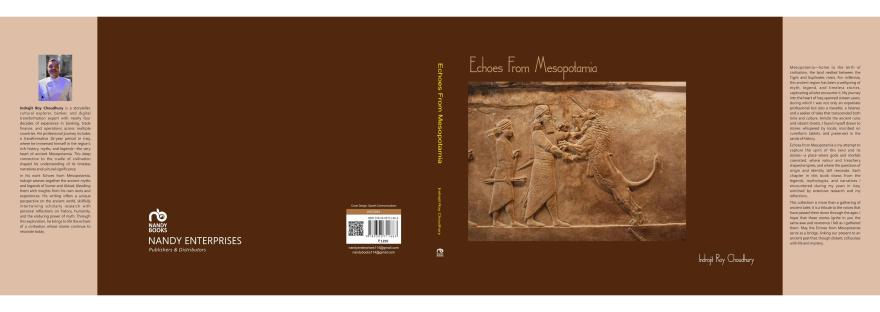
There are moments in life when time gently folds in on itself—when memory, presence, and a long-cherished dream meet in quiet harmony. This January, at the Kolkata Book Fair (Boi Mela), that harmony became a reality. Seeing photographs of my book, Echoes from Mesopotamia, resting on the shelves of the Nandy Enterprises stall was a moment of quiet, profound joy.


It wasn’t just the birth of a publication; it was the culmination of a sixteen-year communion with a land that shaped the very blueprint of human civilization. Mesopotamia. The land between the rivers—the Tigris and the Euphrates. The cradle from which cities, writing, laws, myths, and memories first flowed.
A Land That Never Leaves You
My journey into Iraq began as a professional assignment. Like many expatriates, I arrived with contracts, deadlines, and responsibilities. But Iraq has a way of refusing to remain merely a workplace. It seeps into you—through its dust-laden winds, its ancient ruins standing stubbornly against time, its tea houses, its call to prayer echoing over millennia of history.
Over sixteen years, I lived not merely in Iraq—the modern face of Mesopotamia—but with it, as a traveller, a listener, and a quiet gatherer of stories. Stories overheard in marketplaces and offices. Stories lingered in conversations over endless cups of tea, surfaced between the walls of Babylon, and waited patiently in clay tablets, ancient artefacts, sculptures, and fractured myths—etched in cuneiform, half-buried in time, resting in the hushed halls of the Iraq Museum in Baghdad.
I realised early on that this land does not merely tell stories—it remembers them.
From Whispers to Words: Distilling the Memory
Echoes from Mesopotamia is my attempt to capture those memories before they fade. The book is a collection of legends from Sumer, Akkad, and Assyria—the cradles of writing, law, and urban life.
However, this is more than a historical retelling. It is a personal bridge. Each chapter explores a world where gods walked among humans and where the timeless questions of identity and destiny first emerged.
What fascinated me most was not just the grandeur of these myths, but their uncanny familiarity.
A Bridge Between Civilisations
Among the narratives explored in the book is a compelling and deeply intriguing theory: that the Sumerians—one of the earliest known civilisations—may share subtle yet striking connections with ancient Indian cultures. Parallels in complexion, symbolism, social structures, and cultural motifs raise questions that are as provocative as they are fascinating.
This is not presented as dogma, but as an invitation—to look again, to question inherited assumptions, and to explore the idea that ancient civilisations may have been far more interconnected than we often acknowledge.
In many ways, Echoes from Mesopotamia became a bridge—between West Asia and the Indian subcontinent, between myth and memory, between scholarly inquiry and lived experience.
More Than a Book: A Tribute to Endurance
This work is not merely a retelling of ancient tales. It is a tribute.
A tribute to the unnamed voices who carried these stories across millennia—through invasions, empires, ruins, and rebirths. A tribute to a land that has suffered much, yet continues to pulse with life, dignity, and cultural depth. And a tribute to the enduring power of storytelling itself—the oldest technology humanity ever invented.

Writing this book often felt like listening more than speaking. Listening to history. Listening to place. Listening to echoes that refused to fade.
A Full-Circle Moment in Kolkata
Launching Echoes from Mesopotamia at the Kolkata Book Fair was profoundly symbolic for me. As a city defined by intellectual ferment and a legendary love for the written word, Boi Mela felt like the rightful home for these ancient echoes.

Seeing my niece, Aditi, holding the book amidst the vibrant energy of the fair brought my two worlds together: my roots in India and my professional life in the Middle East. My career has taken me through the worlds of banking and digital transformation, but Mesopotamia gave me a sense of continuity—a reminder that we are all part of a shared human story.
Why These Echoes Matter Today
In an age obsessed with speed and immediacy, ancient myths remind us of something essential: that human hopes, fears, ambitions, and moral dilemmas have changed far less than we imagine. The questions asked in Sumerian temples are not so different from those we ask today.
Who are we? Where did we come from? What binds us together—and what tears us apart?
If Echoes from Mesopotamia succeeds in doing one thing, I hope it is this: to reconnect us, however briefly, with an ancient past that still breathes beneath our modern world.
A Dream Fulfilled, a Conversation Begun
This book is a matter of deep pride for me—not as an endpoint, but as the beginning of a conversation. A conversation across time, across cultures, and across borders. If these stories ignite even a fraction of the wonder and reverence I felt while gathering them, the journey will have been worth it.
To Mr. Debashis Nandy, Mr. Ashish Bannerjee, and all who helped bring this to life—thank you.
May these echoes travel far. May they remind us that civilisation is not a straight line, but a shared memory. And may Mesopotamia—ancient, wounded, eternal—continue to speak.
 Indrajit Roy Choudhury
Many many congratulations 👏🎉
You have again beautifully but hauntingly presented an introduction to the book germinating from and enfolding your lived experiences through the ancientness of a civilization about which we read in history and I personally do not have the courage to imagine visiting.
All the very best for the success of this enormous outcome of a journey which is as personal as propagated by professional requirements.
Thank you so much for these deeply generous words. They mean more to me than I can easily express.
What you call haunting is perhaps the echo of that ancientness itself — a civilization that does not merely invite observation but demands an inner reckoning. I completely understand your hesitation to imagine visiting it; some journeys ask not just for courage of travel, but of introspection.
This book has indeed grown from a space where the personal and the professional could no longer remain separate. If it resonates even faintly with a thoughtful reader like you, then the journey has already found its purpose.
Grateful for your wishes, your sensitivity, and your companionship as a reader on this path.
There is a rare kind of literature that does not merely sit on a shelf, but breathes. Echoes from Mesopotamia: When a Dream, a Land, & History Converge is exactly such a work—a profound tapestry woven from sixteen years of lived experience, silent observation, and a deep, spiritual communion with the cradle of humanity.Reading this book is like sitting in a sun-drenched tea house in Baghdad, listening to the dust of millennia whisper secrets of Sumer, Akkad, and Assyria. The author(that is you) does something far more difficult than historical reporting; you performs an act of cultural alchemy. You takes the “dust-laden winds” of Iraq and the “fractured myths” of cuneiform tablets and transforms them into a living, pulsing narrative that feels as urgent today as it did five thousand years ago.What makes this work particularly striking is its soul. It is clear that this is not a book written by an outsider looking in, but by a “quiet gatherer of stories” who allowed the land to seep into his very being. Your journey from a professional expatriate to a custodian of Mesopotamian memory is a testament to the power of place. Your exploration of the “compelling and deeply intriguing” parallels between the Sumerian and ancient Indian civilizations is not just a scholarly pursuit—it is a beautiful bridging of worlds, connecting the Tigris to the Ganges in a way that feels both provocative and inevitable.To see this book find its home at the Kolkata Boi Mela is a moment of exquisite poetic justice. In a city that vibrates with intellectual fervor, these ancient echoes have found their perfect resonance. You reminds us that while empires fall and cities crumble, storytelling remains our “oldest technology”—the one thing that survives the ruins.Echoes from Mesopotamia is more than a tribute to a wounded, eternal land; it is a gift to any reader seeking to understand the shared blueprint of the human spirit. It is a work of deep pride, immense grace, and a reminder that we are all, ultimately, part of the same shared memory.A masterful achievement that ensures these ancient echoes will, indeed, travel far.🙏🏽🙏🏽
I’m deeply humbled by your words. If Echoes from Mesopotamia breathes, it’s because readers like you listened so attentively to its silences. Thank you for hearing the whispers, for honoring the land, and for carrying these ancient echoes forward with such grace. 🙏🏽
Very nice introduction indeed.
Congratulations to you on this incredible achievement! Publishing your first book is a major milestone, and we, the readers of your blog, are so proud of your dedication and hard work which you have put in to bring an ancient civilisation to life.
This is just the beginning. All the best to you.
Thank you so much for this warmth and encouragement. It truly means a lot to know that the Indrosphere readers have walked alongside this journey. Your support makes the long conversations with history feel worthwhile. Grateful—and yes, this is just the beginning. 🙏🏽
Huge Congratulations on achieving this awesome milestone. Indeed a proud moment for all of us
Thanks, Ashok.
It’s indeed a great achievement. Hats Off. Really proud of you
Thanks, Abhijeet.
Huge achievement Indro. Heartiest congratulations
Eagerly looking forward to reading your book.
Thanks, Shivaji.
Many congratulations Indrajit and superb achievement.
Thanks, Arvind.
আন্তরিক, শুভেচ্ছা। স্বপ্ন পূর্তির সাফল্যর মতো প্রাপ্তি আর কী-ই বা হতে পারে। সম্ভব হলে বইটা পাঠিও।পড়ার আনন্দই আলাদা।
ধন্যবাদ, দাদা।
Proud of your achievement, Dear Indrajit Da . Keep rising to the Horizon and prove your hidden talent
Thanks, Mukesh
This is fabulous.
The lands of Sumeria, Chaldea, Assyria etc are indeed fascinating.
Hihiri Pipri, the fabled homeland of the Santals, they consider it to be in here.
My heartiest congratulations to you for this great work.
Who is the publisher?
I must get this book, it must be available on line.
Thanks. Hihiri Pipri is a new information for me. Nany Enterprises (Nandy Books) are publishers.
Massive congrats! From Mesopotamia to the bookshelf is no small feat. Looking forward to read it.🥳
Thanks, Barhoum.
Congratulations Indrajit, can’t wait to read it. Please share info when available.
Thanks, Morty.
Well done Roy , definitely I will have online when will be available
Thanks, Magdi.
Congrats Bro , I’d love to get a signed copy to readWishing you continued success
Thanks, bro. Sure, My pleasure.
Congrats!
Thanks, Ihsan Bey!
Many Congrats Indro!!
Thanks, Amit
How exciting! Congratulations 🎉
Thanks, Katherine.