
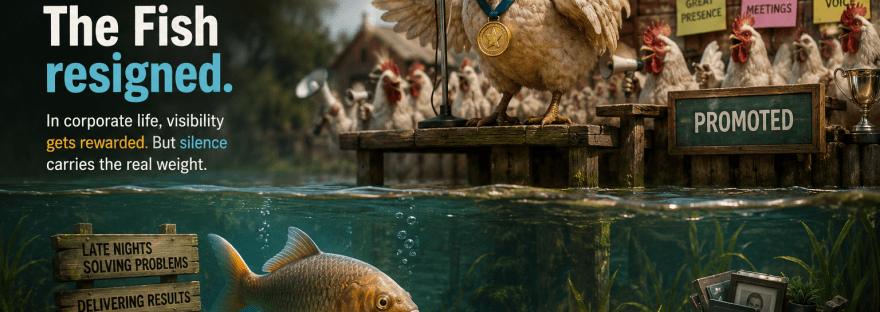
A senior executive once shared an unusual story with me over a cup of tea. “In every organisation,” he said, “there are chickens, and there are fish.” At first, I thought he was talking about agriculture, supply chains, or perhaps some management theory I had missed. Seeing my puzzled expression, he smiled and continued.
“The chicken gets noticed. The fish keeps the pond alive.”
His words stayed with me because, over four decades of banking, digital transformation, and consulting across different countries, I have met both species in abundance.
The chicken is easy to identify. You hear it before you see it.
Every meeting becomes an opportunity to speak. Every presentation carries their signature. Every email arrives with an impressive list of people in the CC field. They are visible, energetic, and remarkably skilled at ensuring everyone knows they are involved.
Then there is the fish. The fish rarely seeks attention.
While others debate ownership, the fish quietly owns the responsibility. While committees discuss solutions, the fish is already implementing them. When systems fail at midnight, when deadlines become impossible, when customers are waiting, and pressure is mounting, it is usually the fish that is working silently behind the scenes.
No drama. No self-promotion. No applause requested. Just results. Yet appraisal season often tells a strange story.
The chicken receives recognition because leadership has “seen the effort.” The fish receives a familiar piece of feedback:
“You need to be more visible.”
Imagine hearing those words after years of carrying critical responsibilities, solving complex problems, and ensuring that everything works smoothly while others take the spotlight.
The disappointment is rarely loud. It begins quietly.
The fish speaks a little less. Volunteers a little less. Cares a little less.
And eventually, one day, submits a resignation letter.
Ironically, the departure often shocks the very leaders who overlooked the contribution.
“Why is he leaving?”
“We never saw this coming.”
But the signs had been there all along.
Months later, the organisation begins to feel different. There are more meetings than ever. More presentations. More status reports. More follow-up calls.
The noise level increases dramatically.
Yet somehow, productivity declines. Projects slow down. Execution becomes uncertain.
Problems that were once resolved effortlessly now linger for weeks.
The chickens are still busy talking. The fish, however, is gone.
And with its departure, the invisible foundation that supported the pond begins to weaken.
Over the years, I have learned that one of the greatest mistakes organisations make is confusing activity with contribution and visibility with value.
The loudest voice in the room is not always the most valuable one.
In fact, some of the most indispensable professionals I have worked with were individuals whose names rarely appeared in presentations, but whose fingerprints were present on every successful outcome.
True leadership requires more than managing performance metrics. It requires the emotional intelligence to recognise quiet excellence.
It requires noticing the dependable employee who never complains, the specialist who solves crises without fanfare, and the team member whose absence would create a vacuum no report can measure.
Because when organisations fail to recognise their fish, they eventually lose them. And when enough fish leave, the pond slowly disappears.
What remains is a very noisy poultry farm.
The lesson is simple: reward outcomes, not merely visibility. Recognise substance, not just spectacle. The future of any organisation depends less on those who talk about the work and more on those who quietly ensure the work gets done.


What a brilliant and insightful analogy! The contrast between the “chickens” and the “fish” captures a reality that exists in many organisations. I particularly appreciated how it highlights the often-overlooked contributions of those who work quietly, consistently, and effectively behind the scenes.
Thank you for your thoughtful comment. That was precisely the message I hoped to convey—that organisations often thrive because of the steady, dedicated efforts of those who work quietly behind the scenes. Their contributions may not always attract attention, but they are frequently the foundation of lasting success.
That’s such an important reflection, and you’ve expressed it with real clarity.
There’s something deeply true in what you’re pointing to—the fact that many systems, teams, and organisations don’t actually move forward because of the loudest voices, but because of the consistent, often invisible effort of people who keep showing up and doing the work without needing recognition.
It almost feels like the quiet contributors form the “circulatory system” of an organisation—unseen, but essential for everything else to function. And yet, their impact often becomes most visible only when it’s missing.
I completely agree that the true strength of any organisation often lies in those who work quietly, consistently, and without seeking the spotlight. Their contribution may go unnoticed in day-to-day operations, but their absence quickly reveals how vital they are to the system’s success and stability. Thank you!