
The International Monetary Fund’s newly released 2026 Annual Report opens with a striking image: a global economy that has absorbed shock after shock and, remarkably, kept standing. Private-sector agility, disciplined fiscal and monetary policy, and a wave of technology investment held growth up and inflation down through most of the past year — enough that the IMF nudged its global growth forecasts upward at the start of 2026.
Then, in late February, war broke out in the Middle East, and the picture changed. The closure of the Strait of Hormuz triggered what the International Energy Agency called the largest-ever single cut to global energy supplies, sending shockwaves through commodity markets and supply chains far beyond the region. It landed at a moment when global public debt was already flirting with levels not seen since World War II.
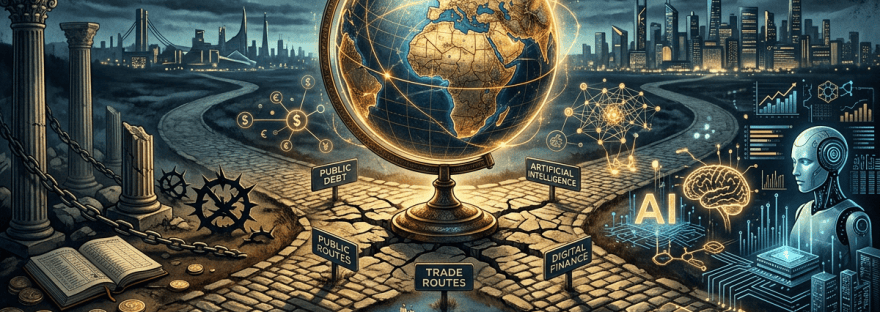
Against that backdrop, the IMF’s report singles out four “In Focus” themes that will likely define the next chapter of the global economy.
1. The Public Purse Is Under Strain
Debt was rising before the war started — the IMF had already projected it would reach WWII-era highs by 2028. The conflict has only added urgency. In just three years, government interest payments have climbed from about 2 percent of GDP to nearly 3 percent — trillions of dollars globally that can no longer go toward education, infrastructure, or other priorities.
Governments are now navigating a difficult balancing act: new defense spending needs are colliding with energy subsidy demands, aging populations, and pressure to protect the most vulnerable. The IMF’s advice is consistent — where subsidies are necessary, make them temporary and targeted; where reform is possible, pursue it, even when it’s politically difficult, because the payoff is fiscal space for the investments that actually drive growth.
2. AI: A Genuine Growth Engine, With Real Fault Lines
Few forces are reshaping the report’s outlook as much as artificial intelligence. AI-related investment may have added half a percentage point to US GDP growth in 2025 alone, and global private investment in AI could top $2 trillion in 2026 — making it one of the fastest-growing drivers of the world economy.
But the report is careful not to tell a simple success story. IMF research finds that workers with AI-related skills are earning more, and so, interestingly, are people in low-skill service roles that support higher earners. The group being squeezed out is the middle-skilled workforce, whose jobs are most exposed to automation without the protection of specialized skills.
There’s a second risk lurking in the AI boom: circular financing. A small cluster of firms — chipmakers, data-center builders, hyperscalers — increasingly act as each other’s customers, investors, and financiers. The IMF is watching this dynamic closely, warning that if the payoff from AI investment proves smaller than expected, the resulting equity correction could cascade well beyond the tech sector.
3. Trade Is Growing, But Resilience Is Strained
Despite the turbulence of 2025, global trade volumes actually rose nearly 5 percent, with technology-related goods leading the way. But the report expects that momentum to slow, compounded by the energy shock from the Middle East conflict.
A structural shift in US trade policy in early 2025 accelerated a broader reorientation of global trade flows, particularly across Asia, as countries negotiated new bilateral arrangements and deepened regional ties. Meanwhile, global trade barriers remain at their highest levels in decades — a reminder that even as countries adapt, the underlying friction in the trading system hasn’t gone away. The IMF’s prescription: predictable, transparent trade policy, deeper regional integration, and a serious effort to correct the large external imbalances — surplus and deficit alike — that leave economies vulnerable to the next shock.
4. Digital Finance Is Moving Faster Than Regulation
Perhaps the most eye-catching figure in the report: the two largest stablecoin issuers now hold more US Treasury bills than Saudi Arabia. Stablecoins and tokenization are reshaping how money and assets move across borders, and Asia — with high mobile penetration but uneven banking access — has become a testing ground for what comes next.
The opportunities are real: cheaper transactions, broader financial access, more liquid markets for government debt. So are the risks — sudden loss of confidence in a stablecoin’s backing assets could trigger destabilizing “flash crashes,” and heavier reliance on privately issued digital money raises questions about monetary sovereignty. Central banks aren’t sitting still; the European Central Bank, for instance, wrapped up the preparation phase for a digital euro in October 2025. The IMF continues pushing for coherent global regulatory frameworks to keep pace with the technology.
The Common Thread
What ties these four themes together is uncertainty — and the premium the current moment places on adaptability. Fiscal authorities need room to maneuver. Workers and firms need to navigate AI’s uneven payoff. Trading nations need to diversify without fragmenting. And financial systems need rules that can keep up with the pace of digital innovation.
As the IMF’s Managing Director Kristalina Georgieva put it in this year’s report, “each new shock only shows more clearly how interconnected we are.” Whether that interconnection becomes a source of collective strength or shared vulnerability may be the defining economic question of the year ahead.


A very insightful and timely overview of the challenges facing the global economy. What strikes me most is that the four themes—debt, AI, trade, and digital finance—are not isolated issues. They are deeply interconnected, and developments in one can quickly affect the others.
The discussion on AI is particularly thought-provoking. Technology can create enormous opportunities for growth and productivity, but its benefits will depend greatly on how effectively workers and institutions adapt to the changes it brings.
Thank you for your thoughtful observations. I completely agree that debt, AI, trade, and digital finance cannot really be viewed in isolation. They are increasingly interconnected, and a shift in one area can create significant ripple effects across the others. Your point about AI is especially important. The technology itself may create tremendous opportunities, but realizing those benefits will depend on how well workers, businesses, governments, and institutions adapt. Ultimately, the challenge is not simply about adopting new technology, but about ensuring that people and institutions are prepared to thrive alongside it.
I truly appreciate your engaging with the post and adding this important perspective to the discussion.