
When we think of high finance, we picture traders buying and selling shares on Dalal Street, investment bankers negotiating billion-dollar deals, or investors tracking stock prices on their mobile phones. We see the visible face of finance: markets, transactions, profits and losses.
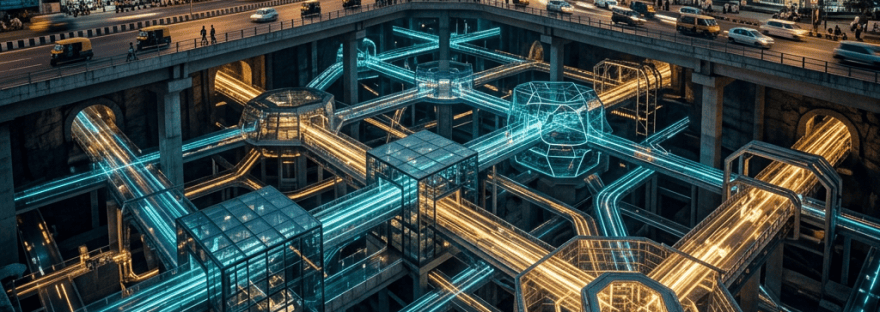
But behind every executed trade, every digital payment and every cross-border bank transfer lies a vast network of institutions, technology and professionals working largely out of sight. This is the world of financial plumbing.
It is the infrastructure that connects financial institutions, transfers money and securities, records ownership, manages risk and ensures that financial obligations are fulfilled. Without it, even the most sophisticated financial markets would struggle to function.
India’s transformation from a banking system dominated by paper-based transactions to one supporting real-time digital payments offers a compelling illustration of how this invisible machinery has evolved.
What Is Financial Plumbing?
Financial plumbing refers to the operational, technological, legal and institutional arrangements that allow the financial system to function.
Just as a city depends on pipes, pumps and drainage networks to deliver water, finance depends on systems that move money, transfer securities, record transactions and settle obligations.
When a customer makes a payment through the Unified Payments Interface (UPI), the visible experience may be as simple as scanning a QR code. Behind that action, however, participating banks, payment service providers, the National Payments Corporation of India (NPCI), security controls and account-settlement processes work together to complete the transaction.
Similarly, when an investor buys shares, the transaction involves more than matching a buyer with a seller. The resulting obligations must be calculated, funds must be collected, and securities must be delivered to the buyer’s account.
The transaction visible to the customer is only the final expression of a much larger financial process.
India’s Financial Plumbing: From Paper to Digital
Indian banking has undergone a remarkable transformation over the past few decades. Earlier, many transactions depended on physical cheques, demand drafts, paper instructions and manual reconciliation. Delays and operational complexity were common.
Core banking systems, electronic fund transfers, dematerialised securities and digital payment platforms have fundamentally changed this environment.
Several institutions now work together to support the system:
- Reserve Bank of India (RBI): Operates key payment and settlement infrastructure, regulates banks and oversees important aspects of payment systems and financial stability.
- NPCI: Operates retail payment systems such as UPI and IMPS.
- Stock exchanges: Provide organised marketplaces where securities are traded and prices are discovered.
- Clearing corporations: Calculate obligations, manage settlement risks and facilitate the completion of eligible trades.
- NSDL and CDSL: Maintain electronic securities accounts and facilitate securities transfers.
- Banks and correspondent banks: Support domestic and international payments, liquidity and trade finance.
These institutions perform different functions, but their activities are closely connected.
Stock Exchanges: The Gateway to Financial Markets
Stock exchanges deserve a place in any discussion of financial plumbing because they form the organised marketplace through which a large part of securities trading takes place.
India’s National Stock Exchange (NSE) and BSE bring buyers and sellers together through electronic trading platforms. They provide the mechanisms for accepting orders, matching buy and sell instructions, disseminating market prices and monitoring trading activity.
Their functions extend beyond simply providing a place to trade.
Price discovery allows the interaction of buyers and sellers to determine market prices. Market transparency gives participants access to information about prices and trading volumes. Market surveillance helps identify unusual trading patterns and potential manipulation. Exchanges also establish listing and trading requirements within the applicable regulatory framework.
In this sense, stock exchanges are part of the market-facing side of finance. They connect investors, brokers and dealers and enable transactions to take place.
However, an executed trade is not the same as a completed transaction.
When an investor buys shares, the exchange matches the order and records the trade. The financial obligations arising from that trade must then be calculated and fulfilled. Clearing corporations, depositories and settlement systems perform these essential functions.
Stock exchanges also operate critical technology and market-monitoring systems. Their trading platforms must remain available, process orders accurately and protect the integrity of market activity.
Thus, exchanges occupy a distinctive position: they are marketplaces in their primary function and providers of critical infrastructure in their operation. They are connected to financial plumbing, but they are not interchangeable with the clearing and settlement systems that complete the trades.
The Core Components of Financial Plumbing
1. Payment Systems
Payment systems move money between individuals, businesses, banks and institutions. In India, different systems serve different needs:
- RTGS (Real Time Gross Settlement): Settles eligible transfers individually in real time, particularly useful for large-value payments.
- NEFT (National Electronic Funds Transfer): Processes transfers through a system of settlement batches and operates around the clock.
- IMPS (Immediate Payment Service): Enables immediate electronic fund transfers.
- UPI (Unified Payments Interface): Supports interoperable, instant retail payments through participating banks and payment applications.
These systems have transformed everyday banking. Individuals can pay merchants, businesses can collect customer payments, and money can move between bank accounts without the delays associated with many traditional methods.
International payments involve additional layers. SWIFT provides secure financial messaging; it does not itself move or settle the money. Banks, correspondent banking relationships and settlement accounts support the actual movement of funds.
For example, an Indian importer paying a foreign supplier may require its bank to transmit payment instructions, use a correspondent banking relationship, comply with applicable checks and arrange settlement in the relevant currency.
The customer sees a payment. The underlying infrastructure coordinates a chain of financial obligations.
2. Clearing and Settlement
Clearing and settlement are among the most important components of financial plumbing.
Clearing determines the obligations arising from transactions, including how much each participant must pay or deliver. Depending on the market, obligations may be netted so that participants settle a smaller number of net amounts rather than every transaction separately.
Settlement is the process through which those obligations are fulfilled: money is transferred and securities are delivered.
Clearing corporations play a crucial role in securities markets. Where a central counterparty arrangement applies, the clearing corporation interposes itself between counterparties, subject to the relevant rules. It manages exposures through measures such as margins, collateral, monitoring and default-management arrangements.
In India, NSE Clearing Ltd. and the relevant clearing arrangements for BSE and other markets support the clearing and settlement of eligible transactions.
The principle of delivery versus payment (DvP) links the transfer of securities with payment, helping reduce the risk that one side delivers while the other fails to pay.
These arrangements do not eliminate all risk. Their effectiveness depends on sound risk management, adequate resources, robust procedures and operational resilience.
3. Securities Depositories: NSDL and CDSL
Before dematerialisation became widespread, investors often held physical share certificates. Maintaining, transferring and verifying those documents could be cumbersome and vulnerable to loss, forgery and delays.
India’s depositories, the National Securities Depository Limited (NSDL) and Central Depository Services (India) Limited (CDSL), support the electronic holding and transfer of securities.
When shares are purchased and settlement takes place, the securities are credited to the investor’s demat account according to the applicable process.
Depositories therefore maintain an essential part of the ownership-record infrastructure. Accurate records, secure access, sound controls and reliable systems are indispensable to investor confidence.
4. The Repo Market and Liquidity
Banks and financial institutions need liquidity to meet payment obligations, fund positions and manage short-term cash requirements. The repurchase agreement, or repo, market helps provide this liquidity.
In a repo transaction, one party obtains funds against securities under an agreement to repurchase them later. The arrangement functions as a form of secured short-term funding.
Repo markets are important in India’s money markets and in the RBI’s liquidity-management operations.
Their smooth functioning depends on participants having suitable collateral, accurate valuations, reliable settlement arrangements and access to funds when obligations fall due.
A market can appear well funded under normal conditions yet experience stress when participants suddenly demand cash or become reluctant to lend. That is why liquidity arrangements form a vital part of financial plumbing.
Who Are the Financial Plumbers?
The people maintaining financial plumbing are often less visible than traders, investment bankers or relationship managers, but their work is indispensable.
They include professionals responsible for:
- Payment processing and transaction operations.
- Clearing, settlement and securities servicing.
- Reconciliation of accounts and financial records.
- Treasury operations, collateral management and liquidity.
- Technology infrastructure, cybersecurity and operational risk.
- Trade finance documentation, compliance and correspondent banking.
Their work ensures that transactions are processed correctly, records agree, discrepancies are investigated and contractual obligations are met.
In banking, an error that appears small—a payment posted to the wrong account, a missed settlement deadline or an unreconciled ledger entry—can have consequences beyond the individual transaction.
The quality of financial plumbing is therefore measured not by how visible it is, but by how accurately and consistently it performs.
Why Financial Plumbing Matters
Financial inclusion and everyday commerce
Digital payment infrastructure has made it easier for individuals, small merchants and businesses to transact electronically. UPI, in particular, has become an important part of India’s digital economy.
Yet access alone is not enough. Payment systems must also be secure, available and supported by processes that resolve failed or disputed transactions.
Businesses, imports and exports
For businesses engaged in international trade, financial plumbing is especially important.
An importer may need a letter of credit, foreign-exchange arrangements, document verification, correspondent banking services and reimbursement to the overseas bank. An exporter may depend on the timely presentation of compliant documents and receipt of payment.
These transactions rely on coordination between customers, banks, messaging networks, operational teams and financial institutions across jurisdictions.
A successful trade is not completed merely when a bank agrees to issue a letter of credit. The documentation must be handled correctly, conditions must be met and the resulting obligations must be fulfilled.
Financial stability
Financial institutions are interconnected. A delay or failure at one institution can affect counterparties and markets elsewhere.
Strong payment systems, clearing arrangements, collateral management, supervision, contingency planning and operational controls help contain these risks.
The objective is not to prevent every disruption—an impossible undertaking—but to reduce the likelihood that a local problem develops into a wider crisis.
When Financial Plumbing Comes Under Stress
Financial crises reveal the importance of infrastructure that normally operates in the background.
The 2008 global financial crisis, culminating in the collapse of Lehman Brothers, exposed weaknesses in risk management, leverage, opaque exposures and counterparty relationships. The crisis was not simply a failure of payment or settlement systems; it demonstrated how financial institutions can become dangerously interconnected when risks are poorly understood or managed.
In September 2019, the US repo market experienced a sharp increase in short-term funding rates. Factors including corporate tax payments, Treasury settlements and the distribution of bank reserves contributed to the pressure. Federal Reserve liquidity operations helped ease the disruption.
In March 2020, the global rush for cash during the pandemic placed severe pressure on markets, including the US Treasury market, normally regarded as among the most liquid in the world. Central-bank interventions were needed to support market functioning.
India faces its own operational challenges as digital finance expands. Cyberattacks, fraud, technology outages, failed or delayed transactions and reconciliation problems can affect confidence. As transaction volumes rise, the ability to identify problems, restore services and resolve outstanding items becomes increasingly important.
These examples underline a common lesson: financial stability depends not only on the strength of individual institutions but also on the systems connecting them.
A Banker’s Perspective: Operations Are a Strategic Asset
Traditional banking language often separates the front office from the back office.
The front office acquires customers, negotiates business and generates revenue. Operations teams process transactions, maintain records, manage documentation and ensure that commitments are fulfilled.
This distinction is useful, but it can also obscure the strategic importance of operational work.
Consider an Indian importer purchasing machinery from overseas through a letter of credit. The relationship manager may secure the business, but the transaction also depends on accurate issuance, appropriate financial messaging, examination of documents, compliance checks, correspondent banking arrangements and eventual settlement.
An error or delay in any of these stages can affect the customer, the supplier and the bank’s reputation.
The stock market offers a similar illustration. A broker may execute an investor’s order on an exchange, but the transaction still depends on clearing, settlement, securities records and the movement of funds.
The front office initiates and develops business. The infrastructure and operations functions help turn that business into a completed financial obligation.
Operational excellence is therefore not merely an administrative function; it is a source of competitive advantage and an essential component of sound banking.
The Future of Financial Plumbing
Financial plumbing continues to evolve.
Artificial intelligence may improve fraud detection, exception handling and operational monitoring. Cloud infrastructure and automation can help institutions scale their services. Tokenisation and new forms of digital settlement may change how certain assets are represented and transferred. Greater interoperability can make financial services more accessible across platforms and institutions.
However, technological speed does not automatically guarantee sound outcomes. Incorrect data, cyber vulnerabilities, unclear legal rights and weak governance can undermine even the most advanced systems.
Financial institutions must therefore combine innovation with appropriate controls, resilient architecture, clear accountability and experienced operational teams.
The ultimate goal is not simply to process transactions faster. It is to create infrastructure capable of supporting trade, investment, financial inclusion and economic growth without compromising trust or stability.
Conclusion: The Infrastructure We Rarely See
Modern finance depends on several connected layers.
Stock exchanges provide marketplaces where securities are traded and prices are discovered. Brokers connect investors to those markets. Clearing corporations calculate obligations and manage settlement risk. Depositories maintain electronic securities records. Payment systems and banks move money, while operational teams ensure that transactions are processed, reconciled and completed.
In India, institutions such as the RBI, NPCI, NSE, BSE, clearing corporations, NSDL, CDSL and commercial banks perform different but interconnected functions within this broader ecosystem.
Their work is not always visible to the public. Its success is reflected in a payment reaching the right account, shares being credited to an investor, a trade-finance commitment being honoured or a market continuing to function during a period of stress.
Financial plumbing is not merely the back office of banking. It is the infrastructure that makes modern banking and financial markets possible.
In finance, the most important systems are often those we notice only when something goes wrong.

