
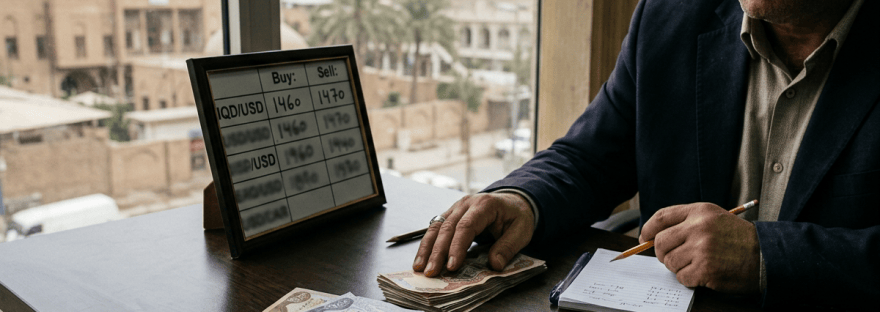
On 7 October, Iraq moved the dinar from 1,320 to 1,520 per US dollar, its first devaluation since 2023. The new structure has three tiers. In dollar terms the dinar lost about 13%. In terms of what a dollar costs, it rose 15%. Reuters’ 14.5% figure is measured against the earlier 1,300 Ministry rate.
| Rate | IQD per USD |
| Central Bank purchase from the Ministry of Finance | 1,500 |
| Sale to banks | 1,510 |
| Sale of cash dollars to the public (new) | 1,520 |
| Previous end-user rate | 1,320 |
The Central Bank of Iraq (CBI) framed the move as a push to support domestic industry, improve the competitiveness of Iraqi goods against imports, attract non-oil investment and create jobs for small and medium-sized enterprises. Most analysts read it differently. One described it as essentially a fiscal response to the shock to oil revenues from the Iran war and disrupted exports. The timing supports that reading, because the government adopted its 2027 budget right before the change.
Why now: the fiscal arithmetic
Oil is nearly 90 percent of revenue, and the Hormuz disruption hit exports hard. The draft budget assumes $58 a barrel, spending of 217 trillion dinars and a deficit above 40 trillion, with exports around 4 million barrels a day. Reserves have been drawn down: CBI data show foreign reserves fell 11.6% in the first half of 2026, from $97.43 billion to $86.17 billion.
Standard Chartered Bank economist says that at the current pace of depletion, Iraq’s foreign reserves could drop to roughly $60 billion by the end of the year, down from over $100 billion at the start of 2026.
Rough arithmetic shows why the Treasury wanted this. At those assumptions, gross oil proceeds are about $85 billion a year. Converted at 1,500 rather than 1,300, that is roughly 17 trillion more dinars. It is a real gain, but it covers less than half the deficit. That is before deducting payments to foreign operators and any shortfall in volumes or prices.
Impact on imports
The effect on import prices depends on which dollar an importer was using. Before the decision, the parallel market sat about 21% above the official rate. Many importers, especially of consumer goods, were already buying dollars at street prices. For them, the official move matters less than what the street does next. Illustratively:
| Importer sourcing | Before → after (IQD per USD) | Approx. cost increase |
| Official-rate dollars | 1,320 → 1,520 | ~15% |
| Street-rate dollars | 1,605 → 1,700 (today, ~1,650) | ~6% (~4%, today) |
Winners and losers also depend on balance sheets. One EPC company in Erbil described the squeeze: clients owe the company in dinars while the company owes foreign suppliers in dollars. Firms with dollar liabilities and dinar receivables, and those with fixed-price dinar contracts, absorb the shock first.
Impact on project costs
The Iraqi Contractors Union asked the Prime Minister to postpone applying the new rate, warning it would raise project costs. A simple rule of thumb is that cost increase is roughly the imported share of the project times the change in the exchange rate. For a project that is 40% imported equipment and materials:
- Sourced at official rates, cost rises about 6%.
- Sourced at street rates, it rises about 3%.
Second-round effects add to this. Local materials, transport, fuel and labour tend to reprice upward over several months.
The burden depends on contract structure. Dollar-denominated or dollar-indexed contracts shift the risk to the employer. Fixed-price dinar contracts leave it with the contractor. Clauses on price adjustment, change in law and currency matter, and so does whether a devaluation counts as a trigger. This is not legal advice, so contractors should have each contract reviewed. Expect a wave of claims and renegotiation requests on public projects.
Inflation
Inflation was low going in: the CBI’s average rate rose from 0.9% to 1.7% between the end of 2025 and April 2026. A low base gives some cushion. A Basra University economist expects the devaluation to let Iraq pay salaries but to lead to a rise in prices. Another analyst warned that prices will not necessarily rise in step with the dollar.
The expectation here, as an estimate rather than a forecast, is a visible step-up in prices of imported foods, appliances, vehicles and building materials. Headline inflation would rise by some percentage points rather than the full 15%, because street-priced goods have already adjusted. The bigger risk is persistence. Rudaw’s analysis warns that continued money printing without output-backed revenue would push inflation into double digits. Fixed-income households, especially public-sector salary earners and pensioners, lose purchasing power in the meantime.
The street premium
The parallel market’s reaction is the sharpest test so far. It touched 180,000 per $100 in Erbil, with sales above 170,000 in Baghdad. At those levels the premium to the new official 1,520 is roughly 12% in Baghdad and 18% in Erbil, down from about 21% before. The gap has narrowed, but it has not closed. Some outlets report quotes even higher, around 1,650–1,685.
Premiums like this have causes a rate change does not remove:
- Limited access to dollars through official channels, and hence demand for the parallel market.
- Dollarized savings and capital flight.
- Dinar liquidity created by deficit financing: the CBI supplied 43 trillion dinars to keep the government funded.
- Expectations that this is the first step in a series.
The CBI says its reserves are strong enough to meet all requests for dollars in full and without restrictions. If that is delivered, the premium should compress, since the arbitrage becomes unattractive. If access stays rationed or confidence erodes, it will not.
Structural change: does it help local industry?
The CBI’s competitiveness argument is true only in principle. As one analyst put it, a weaker dinar could give industry and agriculture more room to compete, but it needs energy, financing, infrastructure, protection against dumping and simpler production procedures. Several features of Iraq’s economy work against a quick supply response:
- Import-dependent inputs. Local factories and farms import machinery, seed, fertiliser and components, so their costs rise too.
- Unreliable power and weak logistics. Cheaper dinars do not fix electricity shortages or border bottlenecks.
- Customs and dumping. Without enforcement, cheap imports still win.
- Public-sector employment. The wage bill is the main spending item, and devaluation does nothing to reduce it.
In short, devaluation changes relative prices. It does not by itself create productive capacity. Historically, oil exporters with weak non-oil sectors see a limited export or import-substitution response, and Iraq’s 2020 devaluation, to 1,450, followed by its 2023 reversal, to 1,300, did not change that.
Is the new rate sustainable?
The reserves cushion is large but shrinking, and the political cushion is thin. Lawmakers have called for an emergency parliamentary session to reconsider the decision, and the rate is tied to the 2027 budget law. A more cautionary reading is that the rate only holds if the parallel market converges toward 1,520 within about 60 days and exports recover toward pre-war levels. That analysis treats a parallel rate beyond 180,000 per $100 as a sign the correction has failed.
The Prime Minister’s financial adviser has argued for halting the continuous use of reserves to fund budget deficits, warning of inflationary and monetary pressures. That is the crux. A rate set at 1,520 is defensible only if the deficit stops being financed by printing and reserve burn.
Verdict: a solution?
It is a stopgap. Devaluation is a reasonable tool when oil revenue collapses and the official rate sits far from the market. It raises dinar revenue, narrows the premium and reduces the incentive to hoard dollars. But it treats a symptom. The disease is a budget that depends on oil, a large public payroll, and monetary financing of deficits.
It becomes part of a solution only if accompanied by:
- A credible one-off adjustment, not a series of steps.
- An end to monetary financing, and spending restraint.
- Real non-oil revenue: customs, taxes, tariffs.
- Protection for vulnerable households, such as ration-card support and targeted transfers.
- Fixes for the supply constraints on local producers.
- Clear contract-indexation rules for public projects.
Three indicators will show which way this goes: the spread between official and parallel rates, inflation and commodity prices, and whether productive sectors benefit. Inflation and a widening gap with the parallel market are the greatest risks. Figures here are from reports over the four days after the decision and the situation is moving fast, so check current rates and any parliamentary action before relying on them.


The real test is whether devaluation builds productive capacity or merely funds a costlier state.
Devaluation increases dinar revenues from oil, but it also raises the dinar cost of foreign-currency obligations, imported public procurement and bank-financed projects. More importantly, it can weaken confidence in dinar deposits, encouraging dollarisation and capital flight.
You are right: devaluation only helps if those extra dinars actually expand productive capacity. When the state is import‑dependent, higher dinar revenues can be cancelled out by higher dinar costs for the same foreign‑priced obligations. And once confidence in the currency slips, dollarisation and capital flight can turn a policy tool into a liability. Without credible reforms to strengthen domestic production and reassure savers, devaluation risks becoming just a more expensive way to run the state.
An insightful and well-structured analysis of Iraq’s currency devaluation and its wider economic consequences. What stands out is the distinction between a short-term fiscal benefit and long-term economic stability. While a weaker dinar may increase government revenue in local currency, it can also raise import costs, squeeze contractors, and erode the purchasing power of ordinary households.
Thank you — that’s a sharp summary of the core tension. Devaluation can create short‑term fiscal breathing room, but it doesn’t automatically translate into long‑term stability. As you note, a weaker dinar raises the cost of imports, strains contractors who rely on foreign‑priced inputs, and reduces households’ real purchasing power. Without reforms that strengthen domestic production and reduce the state’s exposure to dollar‑denominated obligations, the policy risks shifting pressure around the system rather than easing it.
Thank you for this insightful perspective. I completely agree that currency devaluation alone cannot deliver lasting economic stability. Sustainable progress requires structural reforms, stronger domestic production, and policies that protect ordinary citizens from rising costs. Ultimately, economic success should be measured not just by fiscal figures, but by improvements in people’s everyday lives. 🙏
Thank you, sir. I fully agree — devaluation on its own can’t deliver real stability without deeper structural reforms and stronger domestic production. And it’s worth remembering that when the decision was taken, the street premium was already around 21%, signalling serious pressure on confidence and purchasing power. In the end, economic success has to be judged by how it improves people’s daily lives, not just by fiscal indicators. 🙏